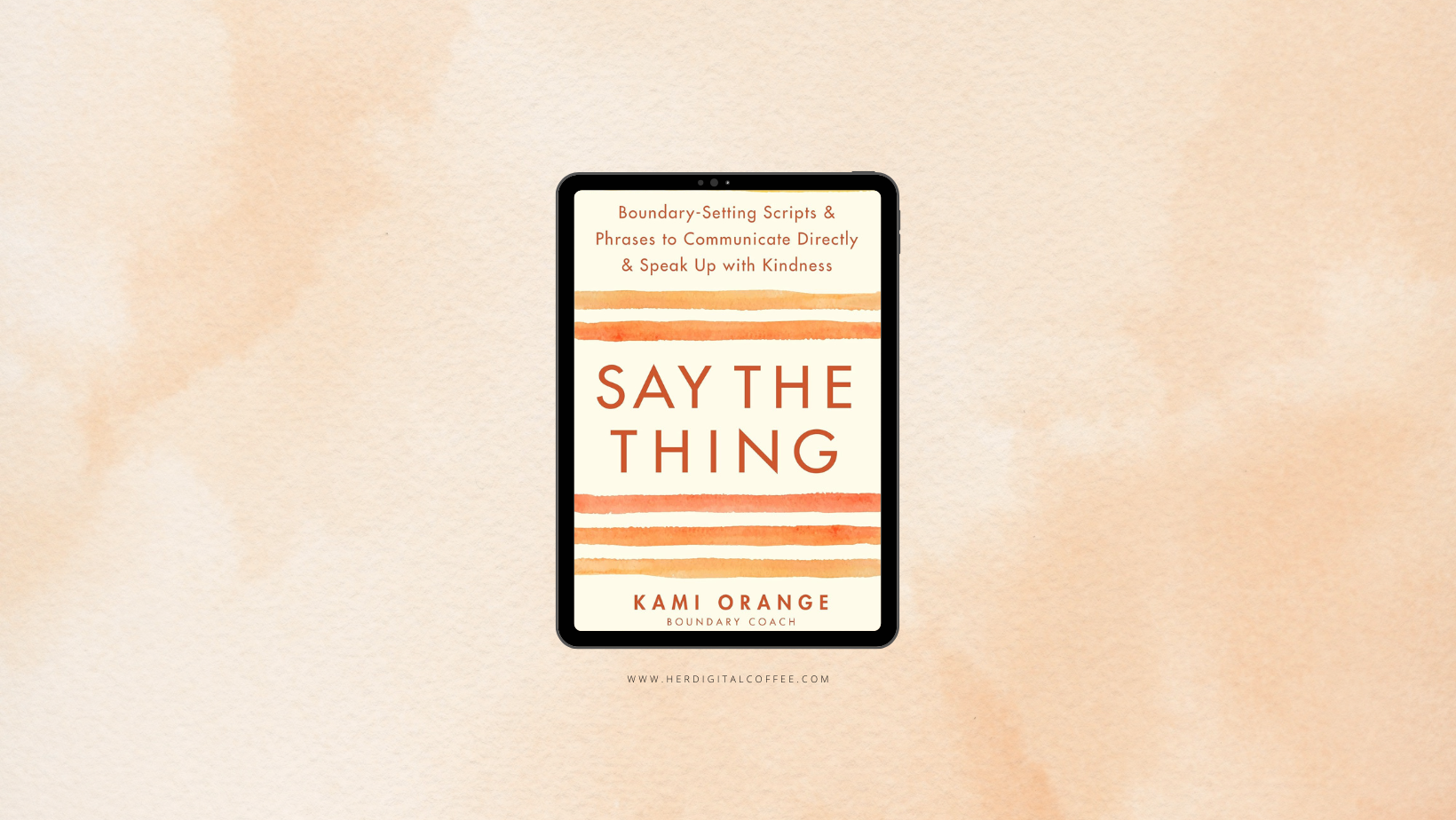
Say the Thing is a self-help book with boundary-setting phrases and scripts that help readers navigate difficult or sensitive topics with confidence. This book covers a wide variety of subjects such as body image, race, relationships, sexual orientation, and more.
Disclaimer: This post may contain affiliate links. If a purchase is made using these links, I will receive a small commission at no extra cost to you. For more information, please visit my Privacy Policy page.
What are boundaries and why do people struggle with them?
According to Kami Orange, a boundary is a communicated expression of what is okay and what is not okay. People struggle with setting clear boundaries because they “don’t want to be a jerk, don’t want to make things worse, or don’t want to upset anyone.”
Setting boundaries can be a difficult thing, especially if people have overstepped time and time again. Instead of confidently saying “no,” you may feel the need to justify or over-explain because you’re used to people not respecting your boundary the first time.
Setting boundaries is not a selfish thing, in fact, it helps others better support and understand you. Orange explains, “Part of having relationships is doing what we can to make life a bit easier for one another. It doesn’t need to be a fight. Boundaries can be a calm conversation between people working together to meet one another’s needs.”
This book has mixed reviews because of how simple and straightforward the examples are, but that’s what I loved about it. Boundary setting doesn’t have to be a complicated thing, it can be as simple as saying “no” or “I’m not interested in continuing this conversation.” You do not need to explain or justify your “no.” Whether it’s from a stranger or someone close to you. If you’re looking for a straightforward book that covers boundary-setting, I definitely recommend picking up “Say the Thing.” Get your copy on Amazon.
Say the Thing by Kami Orange
Genre: Self-Help
Pages: 304
Rating: 4/5

Sounds interesting. Thanks for sharing.
Thanks for reading Hena.
That line about not needing to justify a “no” really stuck with me – it’s the over-explaining that usually trips people up, not the boundary itself. Funny how that applies even outside relationships; in contracting, a clear “that’s not something we do” saves everyone time compared to a long explanation that invites negotiation. Keeping it simple seems to work the same way whether you’re talking to family or a customer asking for a quick favor outside scope. Did the book offer scripts for workplace situations too, or mostly personal relationships?
Thanks for your input, Paul. It did include workplace scripts and they were very straightforward, just like the example you shared.
I actually prefer the straight forward method. When we are in the middle of a challenging situation, it’s difficult to remember, let alone act on more complex advice. Keeping things simple allows us to actually do something, versus just freezing up, due to analysis paralysis.
I absolutely agree. It’s crazy how complicated we can make things out to be sometimes. Thanks for reading Heidi!
Oh wow!!! This book sounds amazing! And you just helped with something. My best friend is looking for a self-help book to read. So I can recommend this book to her. Thank you very much ^_^
I hope she enjoys it! Thanks for sharing it with her Fadima.
I don’t believe I’ve read anything about this subject before so I find it very intriguing. Thanks for sharing your thoughts on it Winnie.
I’m glad it’s something new to explore! Thanks for reading Jodie.